
Click on this link to see new
Click on this link to read sample from new book
DEAR POET: NOTES TO A YOUNG WRITER
Quotes on Writing
Poetry is magic.
It has the power to lift the spirit and unite us.
It transcends all colors, creeds, genders, religions, and political bias.
Poetry heals and soothes the soul.
* * *
Style is not how you write.
It is how you do not write like anyone else.
* * *
Enter the writing process
with a childlike sense of wonder and discovery.
Let it surprise you.
* * *
All children are born poets.
Each one possesses the natural instinct to be creative and express themselves.
Each child sees the world in their own unique way.
Whenever they look up at the passing clouds and see long-tail dragons and sailing ships they are poets.
When they share their vision and dreams they are poets.
They are poets whenever they tell the world who they are, what they think, and how they feel.
As adults, we can encourage those instincts and basic needs by providing them with unstructured time to play, daydream, and explore.
We can encourage and inspire their individual instincts for creativity by filling their worlds of wonder with art, music, dance, wordplay, and rhyme.
* * *
One of our greatest gifts is the ability to simple take time
to appreciate and enjoy the world around us.
Fine-tuning our ability to notice detail
is an important skill of the artist and the writer.
It is an important skill for everyone to enjoy!
Every time you see something new,
take a moment to really get to know the object with your eyes.
Practice this technique on new things that you see.
Take time to rediscover old, familiar objects.
* * *
Poetry is the exaltation of life that keep us alive.
* * *
Poetry is music, theater, dance, art, and literature.
Poetry is winter, spring, summer, and fall.
Poetry is laughter and tears, faith, and fears.
Poetry is life!
* * *
Poetry unites us, transcends all that divides us,
saves us from ourselves and each other.
It is the guiding star that shows us who we are.
* * *
Poems are the little unseen angels
who wear the wings of our best souls.
* * *
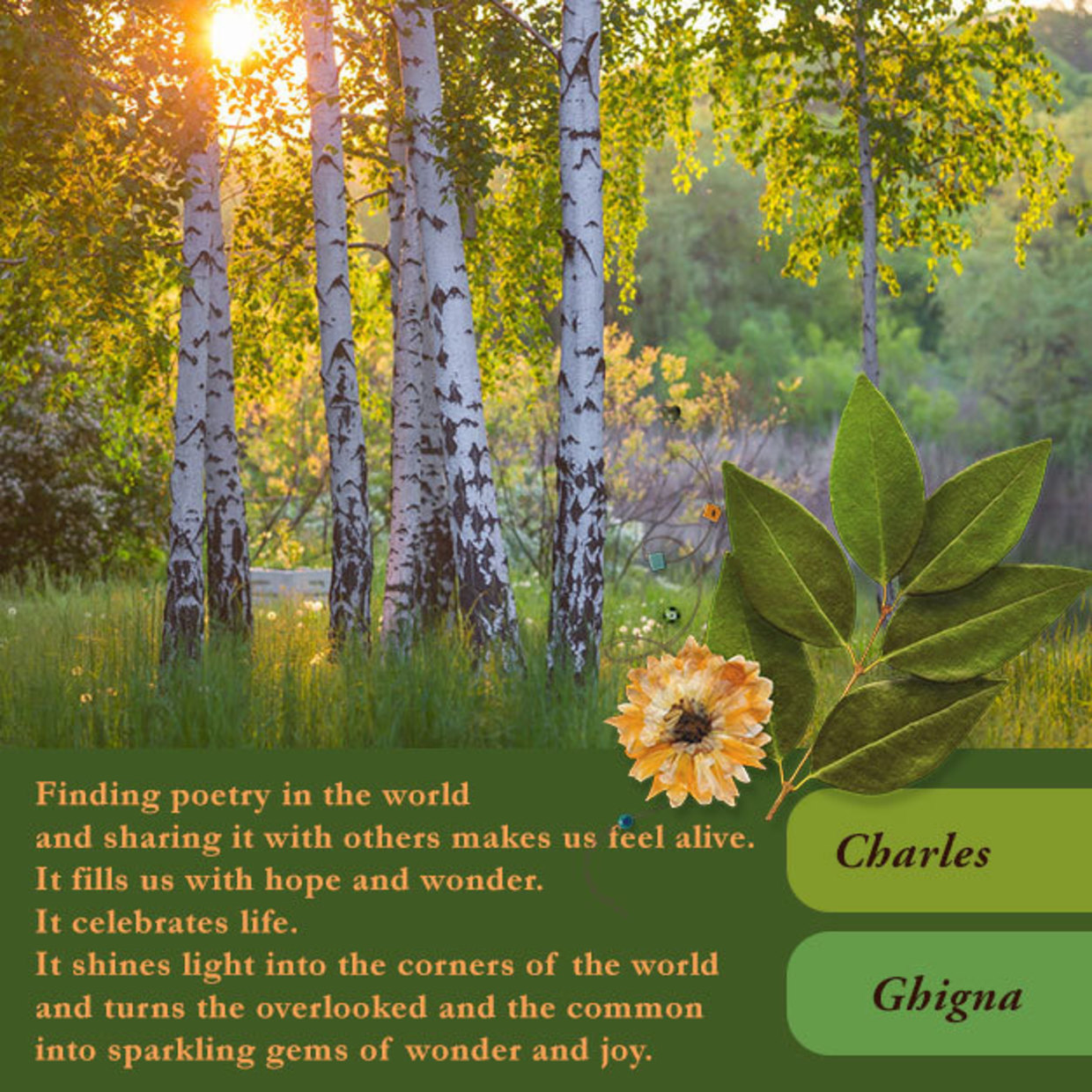
Finding poetry in the world and sharing it with others makes us feel alive.
It fills us with hope and wonder.
It celebrates life.
It shines light into the corners of the world
and turns the overlooked and the common
into sparkling gems of wonder and joy.
* * *
Poems look at the world from the inside out.
* * *
I have the best job in the world! I write books for children.
I wake each day and welcome the wonder, beauty, and joy of the world —
then spend the rest of the day weaving that magic into words to share with children.
* * *
Poetry is the echo of the soul.
* * *
The act of writing brings with it a sense of discovery,
of discovering on the page something you didn't know you knew
until you wrote it.
* * *
Poetry is everywhere!
It's in the smile of a friend and in the sound of the wind.
It's in the scent of the meadow and in the skyline of the city.
It's in the setting sun as she bows her bright orange dress away
into the purple haze of evening.
* * *
Poems come from everywhere.
All we have to do is look -- and listen.
Please click here for more on this subject
* * *
The difference between writing poetry and fiction.
Poetry knocks on the door. Plays coy. Begs for a game of chess.
Fiction grabs you by the throat, throws you to the floor,
and won't let go until you've told the truth, the whole truth,
and nothing but ... the truthful lie.
* * *
How do you know if you're a writer?
Write something everyday for two weeks, then stop, if you can.
If you can't, you're a writer.
And no one, no matter how hard they may try,
will ever be able to stop you from following your writing dreams.
* * *
You can find your writer's voice
by simply listening to that little Muse inside
that says in a low, soft whisper, "Listen to this...
* * *
Poems for children help them
celebrate the joy and wonder of their world.
Humorous poems tickle the funny bone of their imaginations.
* * *
I feel more alive when I am writing.
* * *
My wish is that my words may live beyond me
and that future generations might read my words alive again
and feel more alive with me.
* * *
Writing is like breathing.
In hale inspiration.
Exhale poetry!
* * *
There are many fine poets writing for children today.
The greatest reward for each of us is in knowing that our efforts
might stir the minds and hearts of young readers with a vision
and wonder of the world and themselves that may be new to them
or reveal something already familiar in new and enlightening ways.
* * *
The path to inspiration starts
Beyond the trails we've known;
Each writer's block is not a rock,
But just a stepping stone.
* * *
When you write for children,
don't write for children.
Write from the child in you.
* * *
The answer to the artist
Comes quicker than a blink
Though initial inspiration
Is not what you might think.
The Muse is full of magic,
Though her vision’s sometimes dim;
The artist does not choose the work,
It is the work that chooses him.
* * *
Poem-Making 101.
Poetry shows. Prose tells.
Choose precise, concrete words.
Remove prose from your poems.
Use images that evoke the senses.
Avoid the abstract, the verbose, the overstated.
Trust the poem to take you where it wants to go.
Follow it closely, recording its path with imagery and metaphor.
Rhymes are the ebb and flow of the poem, the melodic waves that pull the reader and listener
into the poem by the ear and carry the meaning and narrative along like a gentle flowing river.
The just-right rhymes are original and unexpected,
yet so smooth and subtle they go unnoticed as simply a part of the flow.
What's A Poem?
A whisper,
a shout,
thoughts turned
inside out.
A laugh,
a sigh,
an echo
passing by.
A rhythm,
a rhyme,
a moment
caught in time.
A moon,
a star,
a glimpse
of who you are.
I also like rhymes whose spellings do not look like they rhyme when you see them,
but offer a subtle little ah-ha moment when you say them.
An example of that kind of rhyme are the words "trees" and "please" and "one" and "begun.”
A Poem is a Little Path
A poem is a little path
That leads you through the trees.
It takes you to the cliffs and shores,
To anywhere you please.
Follow it and trust your way
With mind and heart as one,
And when the journey’s over,
You’ll find you’ve just begun.
I try to avoid using rhymes that are obvious and whose end rhymes sound
like the ping of an old typewriter coming to the end of its carriage.
One of my all-favorite writer of rhymes
and book of rhymes is "A Children's Garden of Verses" by Robert Louis Stevenson.
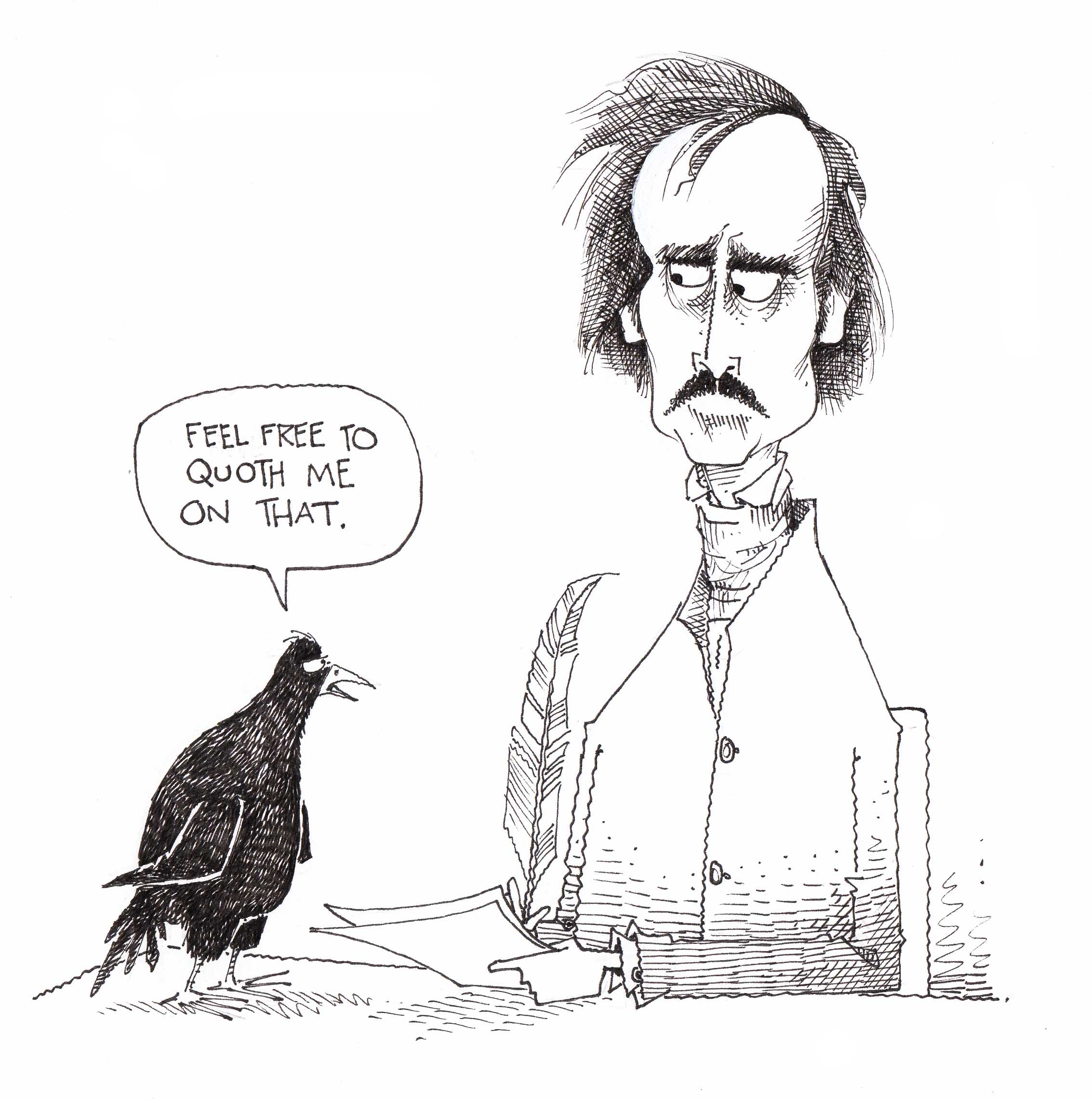
Other favorite rhyming poets include Edgar Allan Poe, Robert Frost, Elinor Wylie, Sara Teasdale,
Edna St. Vincent Millay, Myra Cohn Livingston, and Rachel Field.
A poem is a spider web
Spun with words of wonder,
Woven lace held in place
By whispers made of thunder.
A poem is a busy bee
Buzzing in your head.
His hive is full of hidden thoughts
Waiting to be said.
His honey comes from your ideas
That he makes into rhyme.
He flies around looking for
What goes on in your mind.
When it is time to let him out
To make some poetry,
He gathers up your secret thoughts
And then he sets them free.
Workshop advice.
Stop attending workshops.
Read other writers if you must,
but save your soul and (and your right brain!)
and stay away from how-to workshops.
Inspiration comes from within, not from without.
Writing workshops can drain you of your inspiration
and creativity and leave you writing like everyone else.
Hold on to what little originality you have left from childhood.
Protect it. Nurture it. Let it run wild. That's all you have.
That's all you need. The only way to learn to write is to write.
There is no other way. Workshops and conferences can only
take you away from the real work, the real world, of writing.
Nursery rhymes are magic! They are a child's first introduction
to the joy of language and to the enchanted world of books. Their
lilting rhythms and rhymes, their short, simple sentences and their
clever repetition of key words and phrases start children's eyes, minds
and hearts dancing along the rhythmical lines of poetry and into a
lifelong love of lyrical language. It is the joyous power of poetry
that turns listeners into readers and readers into writers.
When you open a book with a child,
you open the door to a lifelong love of learning.
I have the best job in the world. I write books for children.
Books are magic carpets. They take us all around the world.
My books have taken me all over America, from Alaska to Florida,
from New York to California and everywhere in between.
They have taken me to South America, England and France.
People often say to me, "You're an author.
You can live anywhere in the world you choose."
I smile and reply, "I know. That's why I live in Alabama."
~ Quotes on Art ~
Art can move us to question and examine, to ponder and celebrate,
to see and feel and understand ourselves and the world around us
beyond what we thought possible.
To the artist who thinks every piece of art must make a statement.
Art does not have to make a statement. Art is a statement,
a visual statement of what it means to be alive.
* * *
Life's Greatest Lesson
To learn to live at peace with each other and ourselves
...and to enjoy a bit of music, art, and poetry along the way.
Fully Alive
No one ever feels so fully alive
All the way down to the bone
As when they are free to discover
New places on their own.
* * *
Make Art Because You Love To
Make art because you want to, need to, have to!
Paint What You Feel, Not Want You Think
Good art is intuitive. Feel it. Paint the feeling.
Creation Does Not Come From the Outside In
Art comes from the inside out. It is already in you. Let it out.
Paint Fast and Fearlessly
Your brush is an extension of you. Use your whole body, not just your arm and wrist.
Forget the Color Wheel
There are no primary or secondary colors. There is only color. Make your own.
Put the Critics on Mute
Art is a silent visual song. Turn off the chatter. Listen to your own music.
Good Art Takes Time
Take time to make good art.
The library is the heart and soul of the community.
It is there where we find the golden key
to the kingdom of knowledge and inspiration.
I love librarians.
I love them so much, I married one.
My wife was the first librarian at the
Alabama School of Fine Arts.
Children are born with a curious heart
and an open mind eager to explore their world.
As parents it is our job to nurture their natural desire to learn.
As authors and educators, we would be wise to borrow
a page from the doctors' Hippocratic Oath.
We must "first do no harm."
We must not let our own desire to teach
get in the way of the child's natural instinct to learn.
Inspiration, along with education, is the key.
Rare is he who embraces his own solitude,
yet it is there in the sweet silence of our thoughts
that we encounter our deepest understandings,
discover the seeds of our greatest imaginings.
When you play the game for fun,
You've already won.
To dress in style,
Wear a smile.
Time is a river.
Go with the flow.
Click here for more quotes by CHARLES GHIGNA from Merriam Webster Quotations